Marlo Display Font: Bold, Chic & Craft-Ready
If you’ve ever stared at a blank label, a plain invitation template, or a bare wooden sign wondering how to make it *feel* special—like something your customers will pause for, photograph, and remember—then Marlo is the kind of display font that quietly solves that problem. It’s not just decorative; it’s intentionally crafted for makers who need beauty *and* function in equal measure.
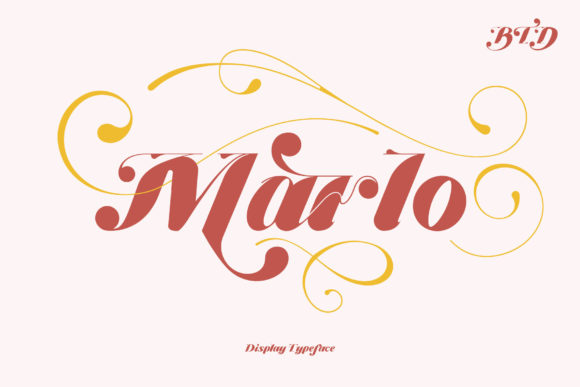
Marlo is an incredibly chic, ravishing, and bold display font—neatly drawn, highly detailed, and built with real-world production in mind. Its curves have confidence, its contrast feels intentional, and its rhythm holds attention without sacrificing clarity. It’s the kind of typeface that makes “small batch” feel luxurious and “handmade” feel polished. Whether you're designing a candle label for your Etsy shop or drafting a welcome board for a rustic wedding, Marlo adds presence—not noise.
Where Marlo Shines in Physical & Digital Craft Projects
Because Marlo is a true display font—not meant for body text but designed to command focus—it works best where impact matters most: headlines, names, titles, and short, meaningful phrases. Think “Hand-Poured Soy Wax,” “Est. 2023,” “The Smith Wedding,” or “Farmhouse Kitchen.” These aren’t throwaway words—they’re brand anchors. And Marlo treats them like it.
You’ll find Marlo especially effective on:
- Candle, soap, and apothecary labels — Its bold weight holds up beautifully when printed small (down to 14–16pt), and its clean terminals cut cleanly on Cricut and Silhouette machines.
- Wedding stationery — From foil-stamped invitations to acrylic welcome signs, Marlo’s elegance reads as timeless, not trendy. Try it for couple names or monograms—it has just enough personality to feel personal.
- Printable wall art & planner pages — As a digital download creator, I use Marlo for quote-based SVG files and minimalist printable sets. Its PUA encoding means swashes and alternates appear reliably in design software—no glyph hunt required.
- Boutique product tags & packaging — That little kraft paper tag tied to a linen pouch? Marlo gives it quiet authority. It pairs naturally with earthy textures and clean layouts.
- Seasonal craft designs — For holiday mugs, tote bags, or farmhouse-style signs (“Gather,” “Joy,” “Home”), Marlo balances warmth and structure—never too fussy, never too flat.
Readability + Real-World Production Tips
Here’s what I’ve learned after using Marlo across dozens of physical products: it’s highly readable *when used intentionally*. Don’t try to set full paragraphs in it—but do trust it for 1–5 word statements at sizes 24pt and up on printed cards, or 36pt+ on signage. On small stickers (under 1.5”), stick to single words or initials—its fine details shine best with breathing room.
For cutting machines: Marlo’s outlines are smooth and well-hinted. No jagged edges, no unexpected breaks. Just clean vector paths that convert flawlessly to SVG or DXF. And because it’s PUA encoded, accessing swashes, ligatures, and stylistic alternates is seamless—no digging through character maps or guessing Unicode values.
Smart Pairings That Elevate Your Designs
Marlo doesn’t need to stand alone—and it shouldn’t. Its bold personality plays beautifully off quieter companions. My go-to pairings:
- With a clean sans serif (like Montserrat, Lato, or Inter) for contrast and balance—ideal for product labels where Marlo handles the brand name and the sans handles ingredients, care instructions, or sizing.
- With a delicate script or handwritten font for wedding or greeting card work—Marlo as the headline, a softer script for “Mr. & Mrs.” or “With Love.” The contrast feels intentional, not chaotic.
- With a warm, low-contrast serif (think Playfair Display or Cormorant Garamond) for editorial-style printables or boutique packaging—Marlo leads, the serif supports.
Avoid pairing Marlo with other heavy display fonts or overly ornate scripts. Its strength lies in clarity and control—not competition.
Licensing You Can Actually Use
This matters: Marlo is a commercial font, and its license covers exactly what we do. You can use it to create and sell physical products (stickers, mugs, shirts), digital downloads (printables, Canva templates, SVG bundles), client work (invitation suites, logo lockups), and even merchandise with your own branding. No extra fees. No murky “personal use only” limits. Just straightforward permission to build your business around beautiful typography.
That said—always double-check the license file included with your download. Some vendors include extended rights for web embedding or app usage, but for crafters and sellers, the standard commercial license is more than enough. Just keep your copy legitimate and your projects authentic.
Why Marlo Fits Into Your Creative Workflow—Not Just Your Wishlist
There’s a difference between a font that looks good on a mockup and one that performs across materials, machines, and markets. Marlo bridges that gap. It’s detailed enough to feel premium, but sturdy enough to hold up on kraft paper, vinyl, ceramic, and matte cardstock. It’s expressive without being exclusive—customers recognize its quality, not its complexity.
When your product sits next to ten others on an Etsy search page—or on a shelf at a local market—Marlo helps yours land first visually and last emotionally. It says “carefully made” before anyone reads a word. And in handmade commerce, that subtle signal often closes the sale.
So if you’re refreshing your font library this season—not for trend-chasing, but for better labels, stronger branding, and designs that truly represent your craft—Marlo isn’t just another pretty face. It’s a practical, production-ready tool. One that earns its place in your folder of go-to design assets.